

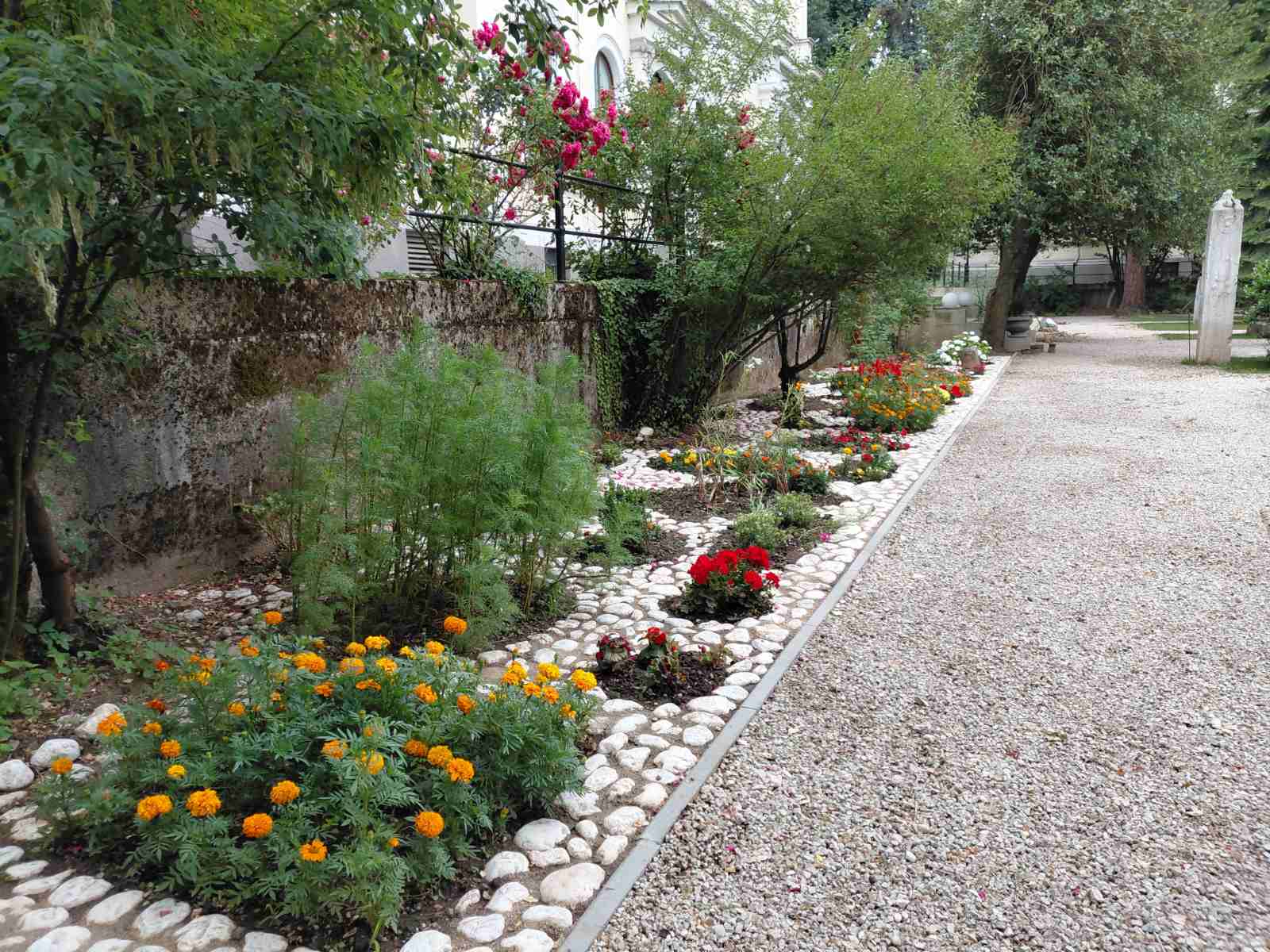
The Fragrance of Bosnian Courtyards
The courtyard is part of the cultural and historical heritage, whose original form has been endangered by the continuous development of the urban area.
In Bosnia and Herzegovina, throughout history, different styles of garden and landscape composition have emerged. A special place and significance belong to the home garden (Šćitaroci, 1992) created during the period of Ottoman rule – the Bosnian flower courtyard. A characteristic feature of oriental-Islamic architecture within a residential building is the courtyard, which occupies a central place and, together with the garden, connects the interior and exterior space. The size of the courtyard primarily reflects the owner’s wealth and its location. Most often, the courtyard encompasses the entire open space from the entrance gate to the house. Its shape is always geometrically regular, rectangular, with retaining walls built on sloped terrain. By its position and function, the courtyard represents an extension of the house and serves as a living room, where during the summer a large part of the family’s daily activities takes place. Together with the garden, it represents an original approach to garden design, and its valorization and evaluation are of exceptional importance in the protection of historical green monuments in Bosnia and Herzegovina (Brguljan, 1985). The originality of the style is the result of the adaptation of Oriental-Mediterranean influences to the needs of the local population in the selection of vegetation and spatial views that are integrated and harmonized with the basic elements of nature and landscape. The overall spatial visual values are achieved by the balance of plant material and other elements of the courtyard.
A typical Bosnian courtyard is recognizable by the specifics of its plant and architectural elements, and the relationship between house and garden. Flowers appear as a basic element (Drljević, 1985), starting from the entrance to the courtyard and the garden all the way to the interior of the house. Decorative plants arrived in courtyards either by spontaneous introduction or by being transferred from the natural environment. Flowers – usually fragrant and brightly colored species – occupy the dominant place in the courtyard . They were planted in flower beds and in pots arranged not only throughout the courtyard but also on staircases, in attics, and in specially designated spaces in front of windows. Contrasts in the courtyard, white cobblestones (light) versus trimmed greenery (dark) or colorful sofas full of flowers, are created through color and structure. The planting of flowering species in the beds is free and asymmetrical, allowing harmonious color arrangements, mong which red stands out as the dominant color. The composition of intense flower colors, the height coordination of plants, and the interplay of light and shadow result in spatial balance and a pleasant living environment for the family.
A specific feature of garden architecture throughout Bosnia and Herzegovina is the clear differentiation between plants cultivated in courtyards—primarily decorative in function—and those grown in gardens as useful plants: fruit, vegetables, spices, and medicinal herbs. The courtyard has pronounced hygienic requirements, to which the present plant species were adapted. The planting of fruit trees was generally avoided, except for selected species such as grapevines grown on pergolas, medlars, apricots, and apples. The courtyard is dominated by flowers—seasonal annuals and biennials that often self-propagate by seed—accounting for approximately 23.78%. Flowering perennials make up 15.24%, bringing the total share of flowering plants in the courtyard to 39.02%.
The proportion of species intended for pot cultivation is low (about 6.09%), characterized by beautiful flower color and fragrance. During the warm part of the year, they find their place in the courtyard, but with the first frost they are brought into the house, most often placed in windows. . A characteristic of the indigenous garden style is the use of geraniums such as Pelargonium zonale, Pelargonium peltatum, and Pelargonium radula as potted plants. Climbers are also essential plant elements, particularly the grapevine (Vitis vinifera) grown on pergolas. In addition to grapevine, a distinctive feature of the traditional garden style is the presence of roses (Rosa), characteristically red in color. Other species include Ipomoea purpurea, Hedera helix, as well as members of the Vitaceae family such as Parthenocissus quinquefolia and Parthenocissus tricuspidata. Trimmed greenery appeared in courtyards during later developmental periods. In the earliest stages, ornamental shrubs were not pruned; boxwood and other evergreen shrubs grew freely. This approach is very rare today.
The selection of species represented in the courtyard is also specific. These were mainly plants with beautifully fragrant flowers. Species with both fragrance and vividly colored blooms prevailed, emphasizing the presence of color. Moss rose (Portulaca grandiflora) grew between the cobblestones throughout the courtyard, making it resemble a natural carpet. Flowers were found in beds, scattered among the cobblestones, and in pots, used to decorate both the courtyard and the house.
With the arrival of the Ottomans, a distinctive color palette in clothing (green, red, yellow, and white) was introduced to Bosnia and Herzegovina, influencing other spheres of life, including the selection of flower colors in ornamental plants present in the courtyard. Red was the favorite color, accompanied by yellow and white.
As a result of the influence of the Islamic garden style, the cult of water was especially emphasized in courtyards and gardens. During Ottoman rule, water supply systems were built, enabling water distribution throughout all parts of the city. This facilitated the construction of fountains—initially public, and later also in courtyards—as well as decorative fountains (šadrvani). The cobblestone paving was made of river pebbles of approximately the same size. Regardless of whether laid in patterns or not, cobblestones were always placed on a flat earthen base. The spaces between the stones were regularly maintained; unwanted wild species were removed by weeding, while flowers were preserved. The obligatory presence of tall white walls served to enclose the intimate family life and fulfill religious customs. The wall did not serve solely as a divider; rather, it brought closer those living behind it, providing intimacy and protecting the family both spiritually and ideologically.
Sitting sofas are grassy areas that were located in the courtyard or garden. They represent wall-enclosed spaces covered with grass, usually situated in the shade with a pleasant view, and were used exclusively for rest. Flower sofas are intended for growing flowers in a permanent place and represent the original basic element of the courtyard in our space. They were raised above the level of the courtyard, which functioned as a communication path. Their shape was regular—rectangular, circular, or hexagonal—depending on their position in the courtyard. Rectangular beds were located along the courtyard or house walls, while circular and hexagonal ones occupied central positions.
Due to rapid construction trends, many cultural and historical monuments in Bosnia and Herzegovina today are not under sufficient protection, particularly the Bosnian flower courtyard. The Bosnian flower courtyard consists of specific plant and architectural elements whose spatial interplay creates original ambiences recognizable as the traditional garden style of the Bosnian house.
Author: Prof. Elma Temim, Ph.D.