

PUBLIC NOTICE
Dear friends of the Museum,
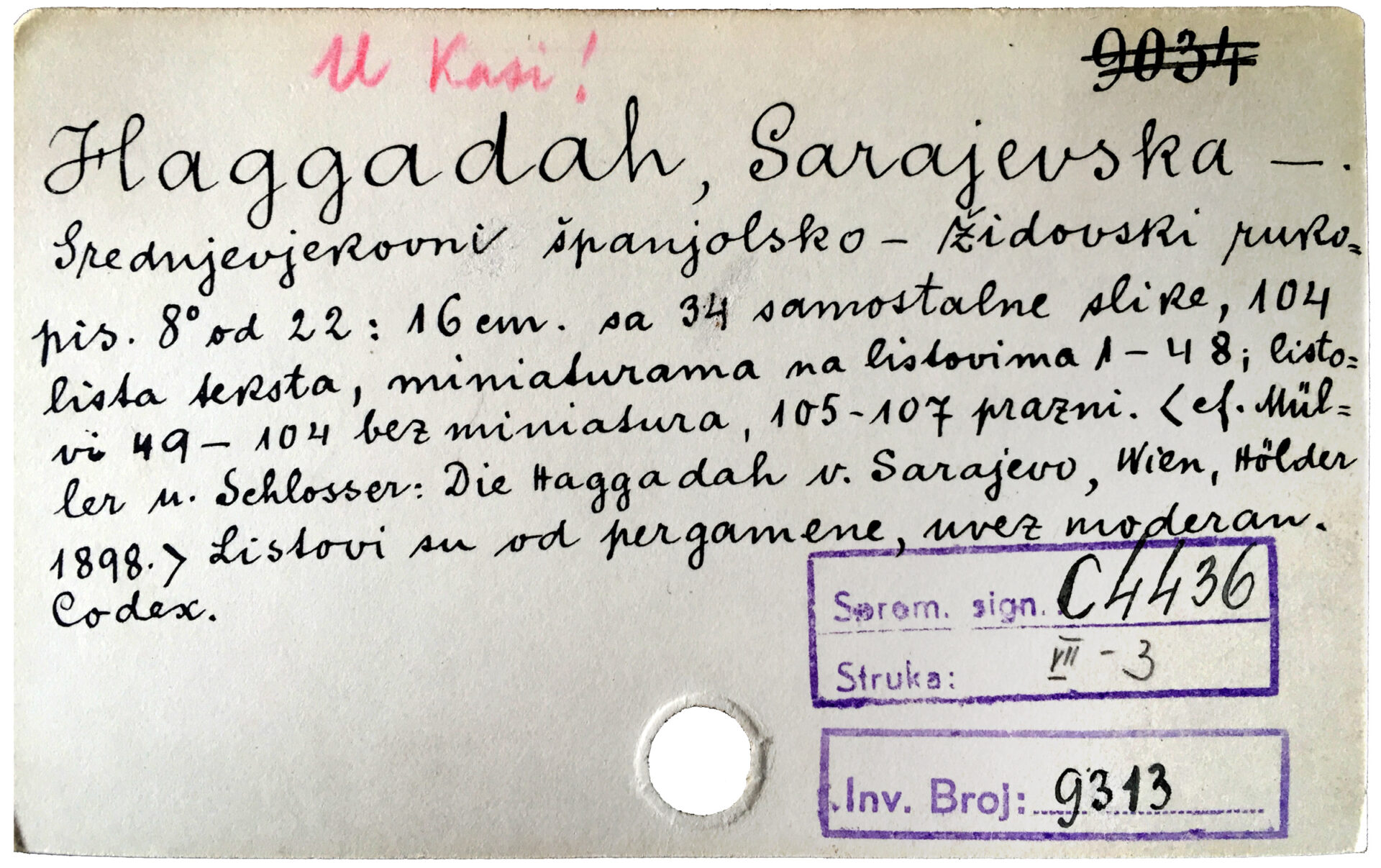
We recently learned through the media that today, March 24, on Capitol Hill in Washington, a presentation of the Sarajevo Haggadah will be organized to mark the beginning of the Passover holiday. The event will be attended by representatives of the U.S. administration, Congress and the Senate, religious communities from Bosnia and Herzegovina and the United States, as well as the Ambassador of Bosnia and Herzegovina to the U.S., H.E. Sven Alkalaj, the Minister of Foreign Affairs of Bosnia and Herzegovina, Elmedin Konaković, and the Chairman of the Presidency of Bosnia and Herzegovina, Denis Bećirović. Accordingly, we believe that the National Museum of Bosnia and Herzegovina is obliged to provide the following clarifications:
- The National Museum of Bosnia and Herzegovina, apart from information obtained through the media, has not been informed of nor in any way—formally or otherwise—involved in the organization of this presentation;
- The organizers of the aforementioned presentation did not request from the National Museum of Bosnia and Herzegovina any information, photographs, or any produced materials related to the Sarajevo Haggadah, such as the facsimile edition “Sarajevo Haggadah, History and Art” or, for example, the exhibition “The Three Lives of the Sarajevo Haggadah.” Of course, we do not dispute the right of political and religious representatives of Bosnia and Herzegovina to promote, independently of the National Museum of Bosnia and Herzegovina, certain items from our collections, as well as the ideas or meanings they carry. However, we must point out that this represents a highly “unusual” practice of bypassing the immediate owner of the artifact. We state this based on previous negative experiences in which we were faced with illegal printing and commercial use of parts or the entirety of the Sarajevo Haggadah manuscript by various associations or publishers, about which we have previously warned without success. We consider it inappropriate for its presentation to be entrusted to unknown individuals without consultation with the Museum staff, in whose custody the manuscript resides.
- Out of its total 138 years of existence, the National Museum of Bosnia and Herzegovina has been the owner of the Sarajevo Haggadah for 132 years. For that entire period, the curators and experts of the Museum have continuously, professionally, and competently cared for, preserved, and protected one of the most famous manuscripts of the 14th century, and likely the most renowned and valuable example of Jewish medieval art overall. In recent years, our institution has made significant efforts to ensure that the preservation and promotion of the Sarajevo Haggadah are carried out according to the highest museological and publishing standards: the space in which the original manuscript is stored and exhibited is equipped in accordance with the highest global conservation and security standards, and it is available for viewing at designated times without a special ticket; the Sarajevo Haggadah has been included in UNESCO’s Memory of the World Register; the exhibition “The Three Lives of the Sarajevo Haggadah” has been organized and successfully presented not only in the region but also across Europe. We are especially proud of the publication of the facsimile and accompanying study “Sarajevo Haggadah, History and Art,” which has been released not only in Bosnian/Croatian/Serbian but also in English and French. These achievements have been realized despite the neglect of all Bosnian and Herzegovinian politicians, not thanks to them.
Nevertheless, we are fully confident that the current Minister of Foreign Affairs of Bosnia and Herzegovina, as well as the Chairman of the Presidency of Bosnia and Herzegovina, will use this opportunity to inform representatives of the U.S. administration about the reasons for—and their personal and institutional, above all successful—efforts to resolve the issue of financing the National Museum of Bosnia and Herzegovina, even 30 years after the signing of the Dayton Agreement. Likewise, we are certain that representatives of the U.S. administration will listen with interest, understanding, and sympathy to the arguments justifying the fact that the famous Sarajevo Haggadah—valued at “700,000,000 USD” and known as “our Mona Lisa”—is still housed in a state institution that, together with its employees, has been kept on the brink of existence for decades and outside any secure funding. If nothing else, we believe they will at least be successful in continuing to support the Museum’s “self-sustainability” by encouraging a new wave of tourists who will come to see the manuscript and purchase the facsimile—since they themselves are unable to do so.